

 Home
HomeProfessional Power Amplifier Rear Panel Functions Explained | Shuoyi Audio
 May 25,2026

 Shuoyi
Many people may not fully understand the functions of a professional power amplifier rear panel. Today, we will introduce the rear panel functions of a professional audio amplifier using a Shuoyi amplifier as an example.
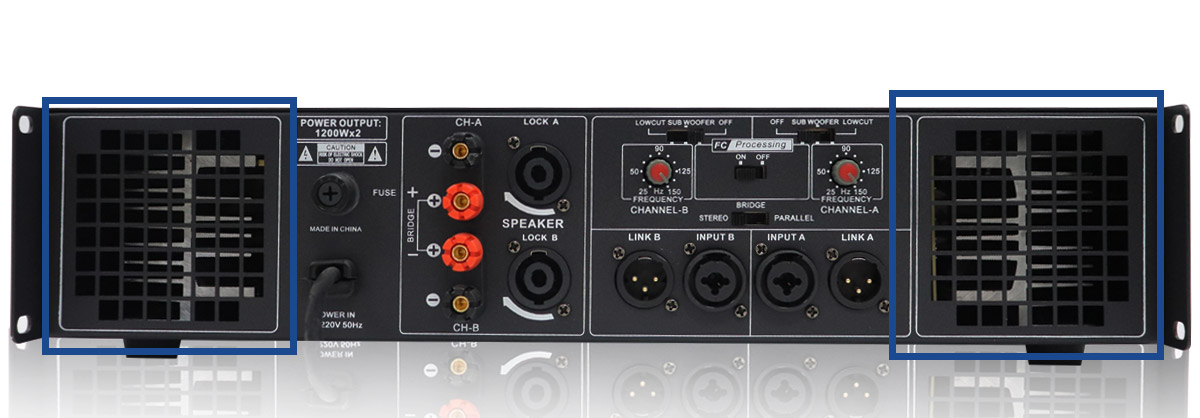
(The blue box indicates the cooling vent.)
Cooling Vents
The ventilation openings on both sides are cooling vents. Their purpose is to help dissipate heat and prevent the amplifier from overheating during long-term operation.
Efficient cooling is extremely important for professional power amplifiers, especially in live sound systems, concerts and DJ applications.
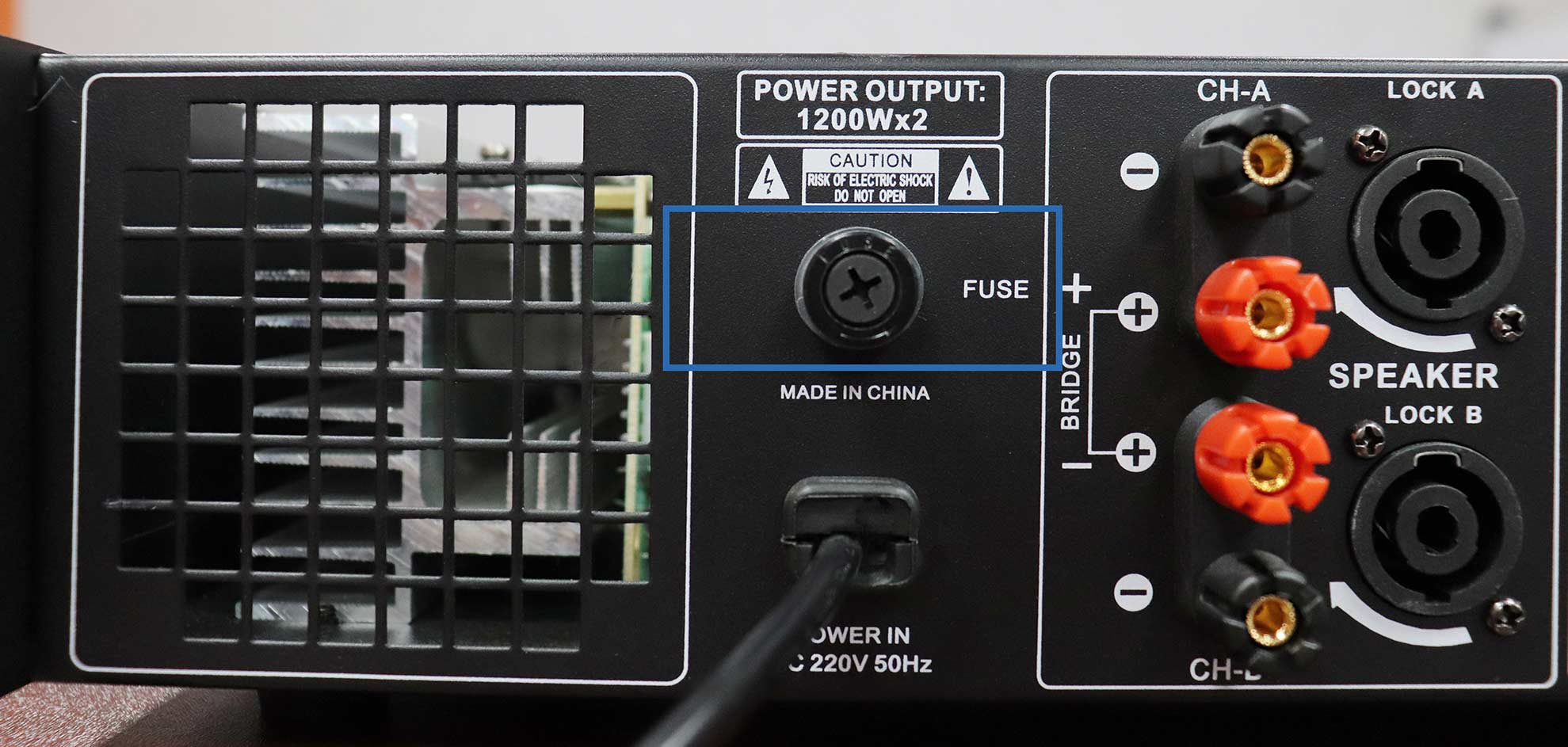
(The blue box indicates the fuse protection.)
Fuse Protection
This is the fuse section of the amplifier.
The fuse helps protect the amplifier from short circuits or electrical faults. If the fuse burns out, simply unscrew the fuse holder and replace it with a fuse of the same specification.
Always use the correct fuse type and rating recommended for the amplifier.
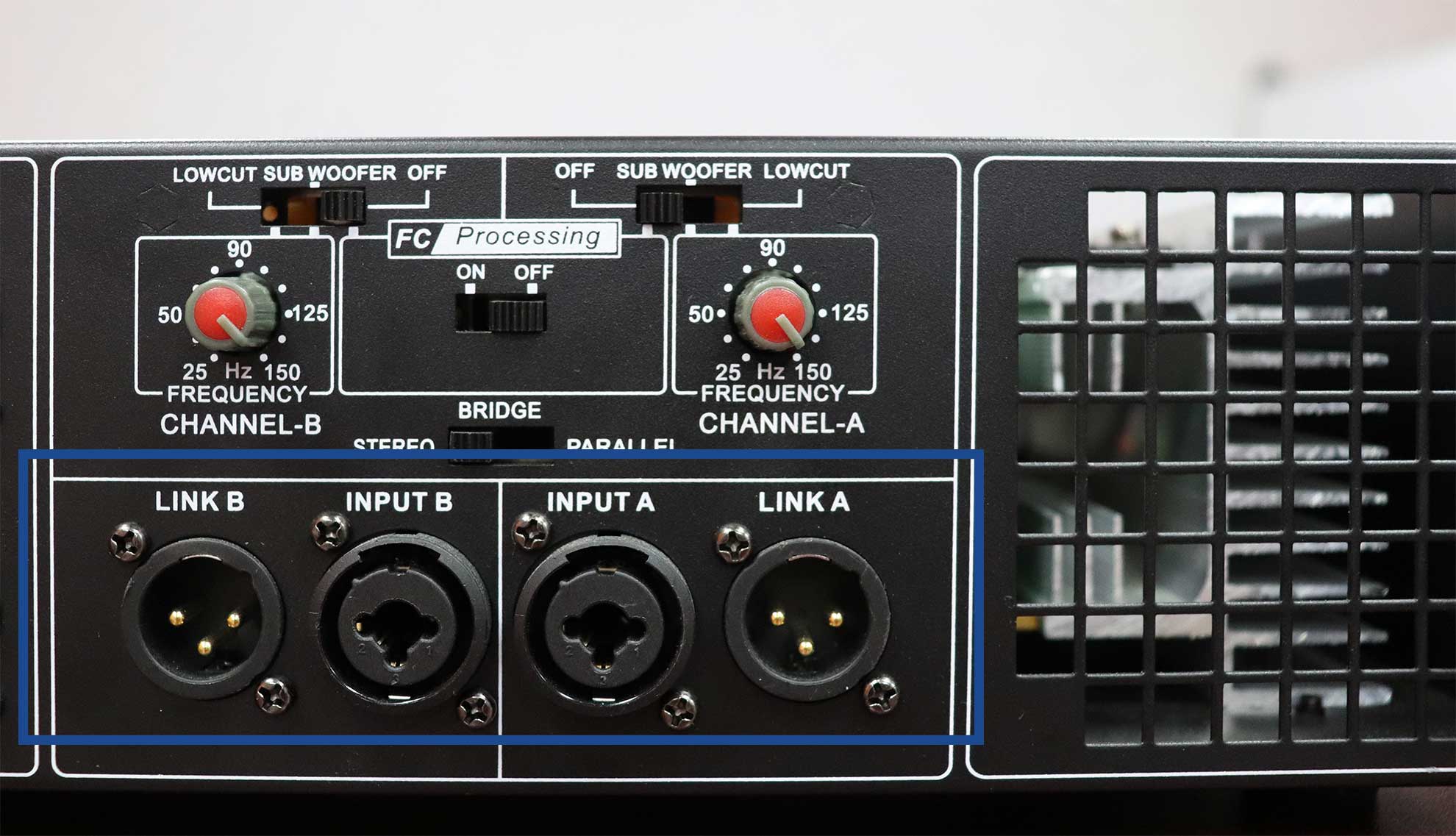
(The blue box indicates the heat dissipation vent.)
Audio Input Section
This area is the input section, used for connecting front-end audio equipment such as:
-
Audio processors
-
Effects processors
-
Crossovers
-
Mixing consoles
INPUT A and INPUT B are combo input connectors that support multiple plug types, making them compatible with different audio connection methods.
LINK A and LINK B are XLR link output connectors used for signal linking or daisy-chaining multiple amplifiers together.
Please note that rear panel functions may vary depending on different amplifier models.
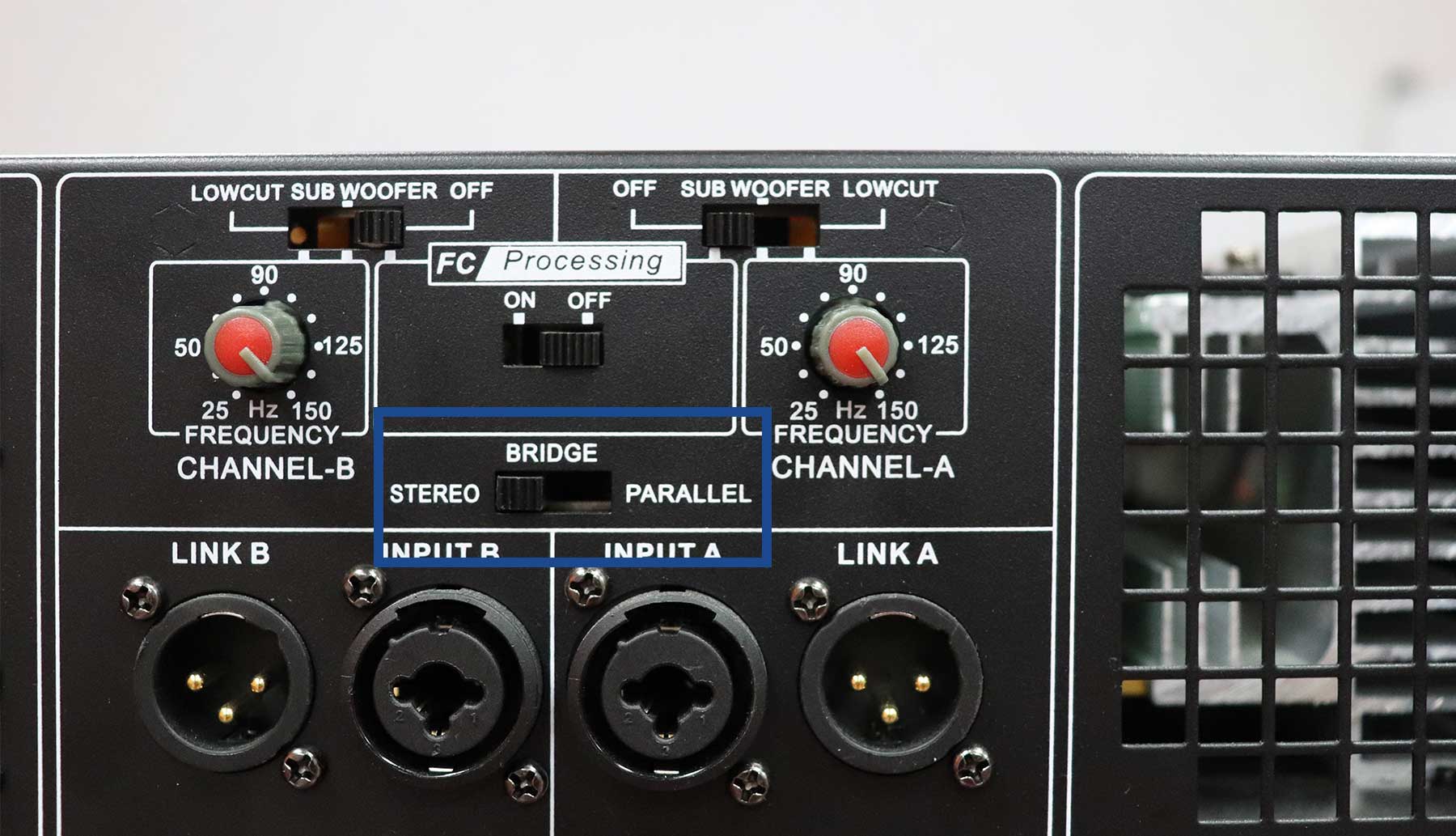
(The blue box indicates the Amplifier Working Modes)
Amplifier Working Modes
This section controls the amplifier operating modes.
There are three common modes:
Bridge Mode:
BRIDGE mode combines two amplifier output channels into a single channel to provide higher power output.
This mode is commonly used for driving larger speakers or subwoofers that require more power.
Mono Mode (Parallel Mono):
MONO mode, also called Parallel Mono mode, copies the signal from Channel A to Channel B.
When only Channel A receives an input signal, both output channels A and B will output the same signal simultaneously.
Stereo Mode:
STEREO mode is the most commonly used mode.
In stereo mode, both channels operate independently without interfering with each other.
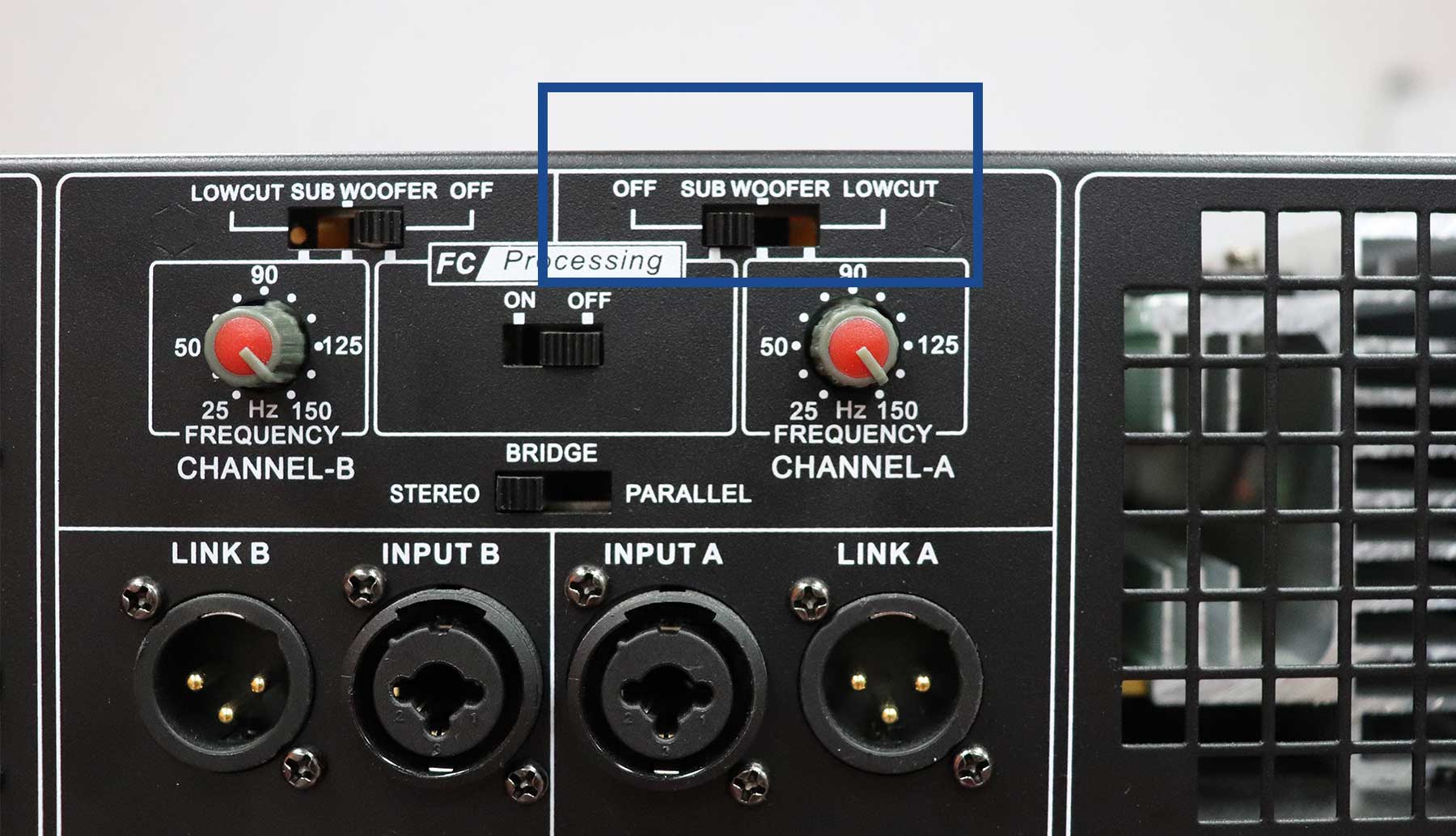
(The blue box indicates the FC Processing)
FC Processing (Frequency Crossover Processing)
FC Processing stands for Frequency Crossover Processing.
This built-in crossover section includes three modes:
-
OFF
-
SUBWOOFER
-
LOW CUT
Subwoofer Mode:
In SUBWOOFER mode, only low frequencies are allowed to pass through.
For example, when the frequency is set to 150Hz, the amplifier will only output frequencies below 150Hz.
Low Cut Mode:
LOW CUT mode removes low frequencies.
When set to 150Hz, frequencies below 150Hz will be filtered out, and only frequencies above 150Hz will be output.
This function is useful for speaker protection and system tuning.
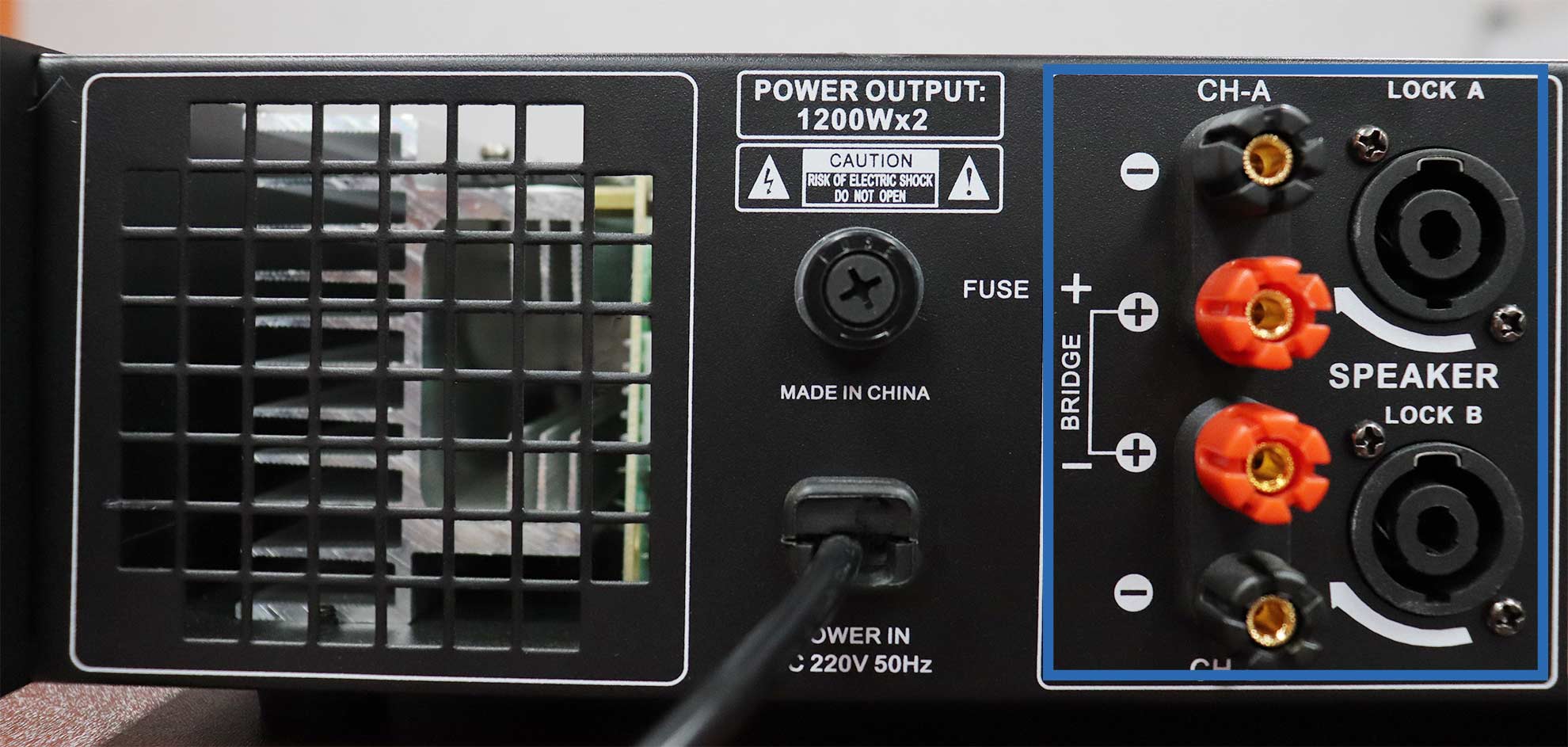
(The blue box indicates the speaker output section)
Speaker Output Section
Next is the speaker output section.
These connectors are used to connect speakers.
Binding Post Outputs:
The binding post terminals on the left support:
-
Bare speaker wire
-
Banana plugs
Please connect the positive and negative terminals according to the markings on the amplifier.
Speakon Connectors:
The connectors on the right are Speakon speaker outputs.
After inserting the connector, it must be rotated to lock into place, providing a more secure and stable connection that is less likely to loosen during operation.
Speakon connectors are widely used in professional audio and PA systems because of their safety and reliability.
Conclusion
That concludes our introduction to professional power amplifier rear panel functions.
We hope this guide helps you better understand how professional amplifiers work and how to properly connect your audio system.
Stay tuned for more professional audio knowledge and amplifier tutorials from Shuoyi Audio.
 Class AB vs. Class H: A No-Nonsense Comparison
 You May Also Like


 Tel
Tel
 Email
Email
 Address
Floor 2, No.16, North 1st Road, Shuikou Avenue, Jinsha East, Danzao Town, Nanhai District, Foshan City, Guangdong Province.